



JCI Slides Almost 2% After Moody’s Cuts Indonesia Outlook
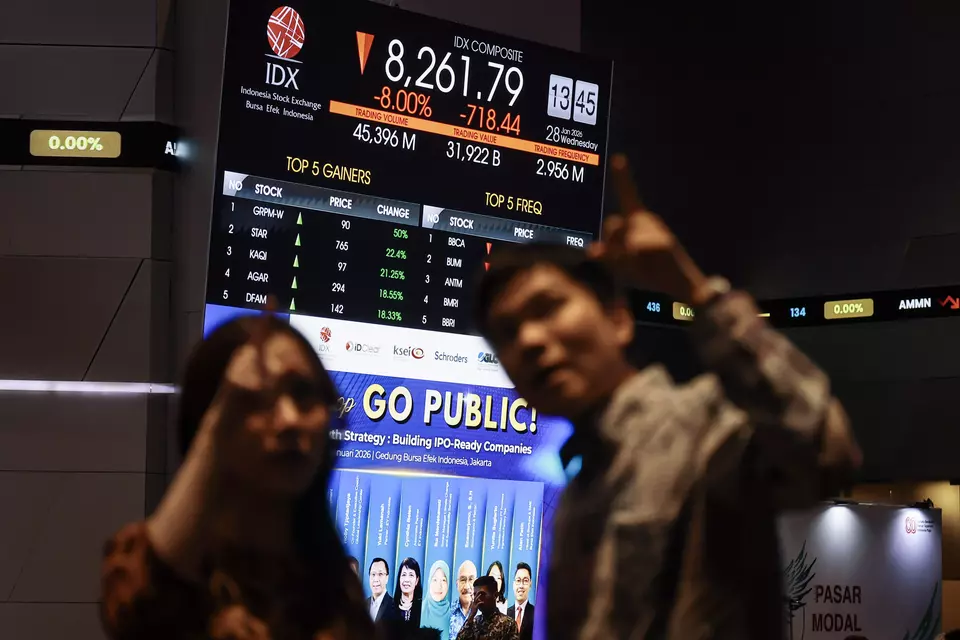
Jakarta. Jakarta Composite Index (JCI) slid sharply on Friday morning, falling 158 points or 1.98% to 7,945, as investor sentiment weakened following Moody’s latest downgrade of Indonesia’s outlook released a day earlier.
In the first ten minutes of trading, the index moved within a range of 7,888 to 7,995. Volume reached 6.46 billion shares, with turnover totaling Rp 3.03 trillion ($179.46 million) across 336,018 transactions. Decliners dominated with 531 stocks falling, compared with 83 gainers and 87 unchanged.
Pilarmas Sekuritas Investindo said the market had already been under pressure from MSCI scrutiny, but Moody’s decision to revise Indonesia’s credit outlook from stable to negative intensified concerns, particularly over policy stability. The brokerage warned that failure to address fiscal pressures, weakening foreign exchange reserves, rising debt risks, and unresolved capital market transparency issues could trigger larger capital outflows. Such developments would weigh heavily on the bond market, as sovereign rating concerns are closely tied to default risk perceptions.
Moody’s also cited ineffective policy communication that could undermine governance quality and policy effectiveness. Pilarmas noted that prolonged deterioration in these areas may erode the credibility of Indonesia’s policy framework, which has long supported solid economic growth, macroeconomic stability, fiscal resilience, and financial market confidence.
Attention has also turned to the state budget deficit. The increase in the deficit ceiling to 3% of GDP raises fiscal risk exposure, with Pilarmas highlighting populist spending programs as a key concern if risks are not properly managed. Over time, this could pressure the broader economy and reshape investor perceptions toward Indonesia’s investment outlook.
Global sentiment added to the downside. Wall Street closed sharply lower on Thursday as technology stocks declined, sending the S&P 500 down 1.2% for its sixth loss in seven sessions since hitting a record high. The Dow Jones Industrial Average dropped 592 points, or 1.2%, while the Nasdaq Composite slid 1.6%.
Labor market signals in the United States further clouded the outlook. Layoff announcements surged to 108,435 last month, the highest since October and the worst January figure since the 2009 Great Recession, according to Challenger, Gray & Christmas. Separate government data showed job openings in December fell to their lowest level in more than five years.
Signs of labor market weakness could push the Federal Reserve toward interest rate cuts to support growth, though such a move risks fueling inflation. Treasury yields declined across maturities in response.
Asian markets followed Wall Street lower on Friday amid concerns that heavy investment in artificial intelligence could strain corporate finances. Japan’s Nikkei fell 0.71% to 53,435, South Korea’s Kospi dropped nearly 3% to 5,013, Hong Kong’s Hang Seng slid 2% to 26,354, and China’s Shanghai Composite lost 0.86% to 4,040.
Tags: Keywords:Related Articles

Indonesian Stocks Rise Despite Foreign Outflows as MSCI Review Looms
Indonesia's JCI rose 2.8% as easing geopolitical tensions offset foreign outflows, MSCI concerns and rupiah pressures.
OJK Moves to Reassure Investors After MSCI Downgrades Information Flow
Indonesia said MSCI's transparency concerns validate ongoing reforms, while maintaining confidence in market access.
JCI Ends Flat-to-Higher as MSCI Review Caps Gains
JCI rose 0.08% after a volatile session as investors weighed MSCI transparency concerns and Fed rate risks.
Analyst: MSCI Report Is About More Than Indonesia's Emerging Market Status
MSCI's latest review flagged transparency and information flow gaps that could weigh on investor confidence in Indonesia.
Jakarta Stocks Weigh BI Rate Hike, MSCI Transparency Concerns
Indonesia kept its MSCI emerging market status, but concerns over transparency and market integrity weighed on stocks.
MSCI Retains Indonesia as Emerging Market, Warns on Market Transparency
MSCI kept Indonesia in its emerging market index but flagged persistent concerns over transparency and FX access.
New IDX Chief Pledges Stronger Governance After Market Volatility
New IDX chief Jeffrey Hendrik pledges stronger governance and transparency after MSCI-related market volatility.
JCI Drops 0.78% as BI Raises Rates and Investors Await MSCI Review
Jakarta stocks fell 0.78% after BI raised rates to 5.75%, while investors awaited MSCI's market review.
OJK Nominates Seven IDX Directors, Jeffrey Hendrik Set to Remain CEO
Jeffrey would be appointed President Director of the Indonesia Stock Exchange after serving in an acting capacity.
Jakarta Stocks Retreat Ahead of Triple Market Tests: BI, MSCI and FTSE
JCI fell 0.46% as investors awaited Bank Indonesia's rate decision and key MSCI and FTSE index reviews.The Latest

Dear Mr. President, Don’t Skip ASEAN Summits
Despite calls for Prabowo to stay home, the Indonesian leader still needs to attend ASEAN summits.
PLN Rushes Coal Supplies After Power Outages Hit Java
PLN is rushing to secure coal supplies after shortages triggered rolling blackouts across Java, disrupting businesses and daily life.
Japan-Backed ADB Invests in Indonesia’s Human Capital
As many as 399 Indonesian awardees have joined the ADB-Japan Scholarship Program from 1988 to 2024.
Indonesian Stocks Rise Despite Foreign Outflows as MSCI Review Looms
Indonesia's JCI rose 2.8% as easing geopolitical tensions offset foreign outflows, MSCI concerns and rupiah pressures.
