Trump Cuts Tariffs on China After Meeting Xi in South Korea
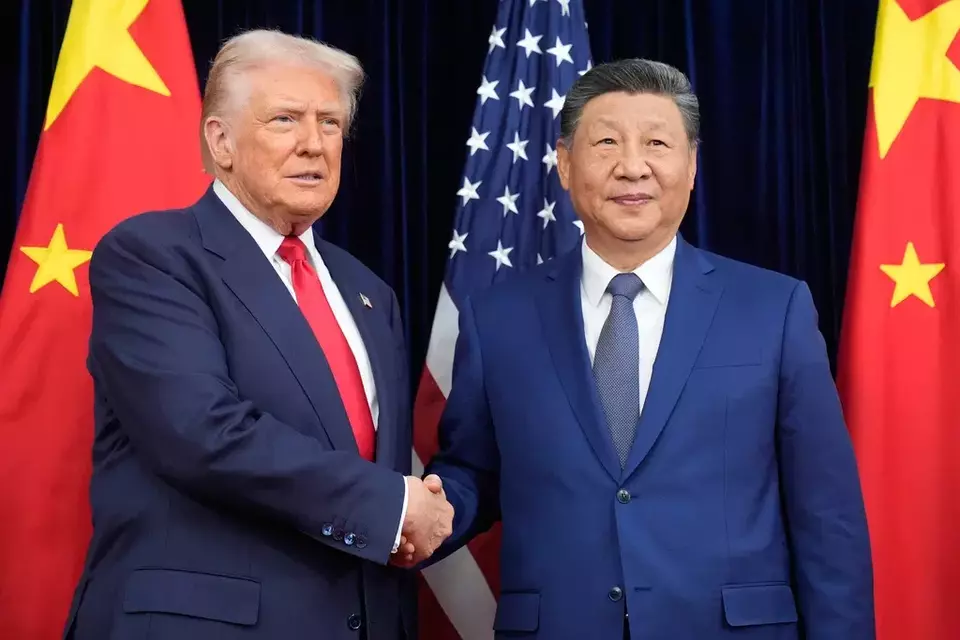
Aboard Air Force One. US President Donald Trump described his face-to-face with Chinese leader Xi Jinping on Thursday as a roaring success, saying he would cut tariffs on China, while Beijing had agreed to allow the export of rare earth elements and start buying American soybeans.
The president told reporters aboard Air Force One that the United States would lower tariffs implemented earlier this year as punishment on China for its selling of chemicals used to make fentanyl from 20 percent to 10 percent. That brings the total combined tariff rate on China down from 57 percent to 47 percent.
“I guess on the scale from 0 to 10, with ten being the best, I would say the meeting was a 12,” Trump said. “I think it was a 12.”
Trump said that he would go to China in April and Xi would come to the US “some time after that.” The president said they also discussed the export of more advanced computer chips to China, saying that Nvidia would be in talks with Chinese officials.
Trump said he could sign a trade deal with China “pretty soon.”
Xi said Washington and Beijing would work to finalize their agreements to provide “peace of mind” to both countries and the rest of the world, according to a report on the meeting distributed by state media.
“Both sides should take the long-term perspective into account, focusing on the benefits of cooperation rather than falling into a vicious cycle of mutual retaliation,” he said.
Sources of Tension Remain
Despite Trump’s optimism after a 100-minute meeting with Xi in South Korea, there continues to be the potential for major tensions between the world’s two largest economies. Both nations are seeking dominant places in manufacturing, developing emerging technologies such as artificial intelligence, and shaping world affairs like Russia’s war in Ukraine.
Trump’s aggressive use of tariffs since returning to the White House for a second term, combined with China’s retaliatory limits on exports of rare earth elements, gave the meeting newfound urgency. There is a mutual recognition that neither side wants to risk blowing up the world economy in ways that could jeopardize their own country’s fortunes.
When the two were seated at the start of the meeting, Xi read prepared remarks that stressed a willingness to work together despite differences.
“Given our different national conditions, we do not always see eye to eye with each other,” he said through a translator. “It is normal for the two leading economies of the world to have frictions now and then.”
There was a slight difference in translation as China’s Xinhua News Agency reported Xi as telling Trump that having some differences is inevitable.
Finding Ways to Lower the Temperature
The leaders met in Busan, South Korea, a port city about 76 kilometers (47 miles) south from Gyeongju, the main venue for the Asia-Pacific Economic Cooperation summit.
In the days leading up to the meeting, US officials signaled that Trump did not intend to make good on a recent threat to impose an additional 100 percent import tax on Chinese goods, and China showed signs it was willing to relax its export controls on rare earths and also buy soybeans from America.
Officials from both countries met earlier this week in Kuala Lumpur to lay the groundwork for their leaders. Afterward, China’s top trade negotiator Li Chenggang said they had reached a “preliminary consensus,” a statement affirmed by US Treasury Secretary Scott Bessent who said there was “a very successful framework."
Shortly before the meeting on Thursday, Trump posted on Truth Social that the meeting would be the “G2,” a recognition of America and China’s status as the world’s biggest economies. The Group of Seven and Group of 20 are other forums of industrialized nations.
But while those summits often happen at luxury spaces, this meeting took place in humbler surroundings: Trump and Xi met in a small gray building with a blue roof on a military base adjacent to Busan’s international airport.
The anticipated detente has given investors and businesses caught between the two nations a sense of relief. The US stock market has climbed on the hopes of a trade framework coming out of the meeting.
Tags: Keywords:The Latest

Dear Mr. President, Don’t Skip ASEAN Summits
Despite calls for Prabowo to stay home, the Indonesian leader still needs to attend ASEAN summits.
PLN Rushes Coal Supplies After Power Outages Hit Java
PLN is rushing to secure coal supplies after shortages triggered rolling blackouts across Java, disrupting businesses and daily life.
Japan-Backed ADB Invests in Indonesia’s Human Capital
As many as 399 Indonesian awardees have joined the ADB-Japan Scholarship Program from 1988 to 2024.
Indonesian Stocks Rise Despite Foreign Outflows as MSCI Review Looms
Indonesia's JCI rose 2.8% as easing geopolitical tensions offset foreign outflows, MSCI concerns and rupiah pressures.
World Cup 2026: Paraguay Holds Off Turkey With 10 Men to Keep Knockout Hopes Alive
Matias Galarza scored after 65 seconds as 10-man Paraguay beat Turkey 1-0, eliminating the Turks and securing first place for the US.Most Popular