US-EU Trade Deal Wards Off Further Escalation But Will Raise Costs for Companies and Consumers
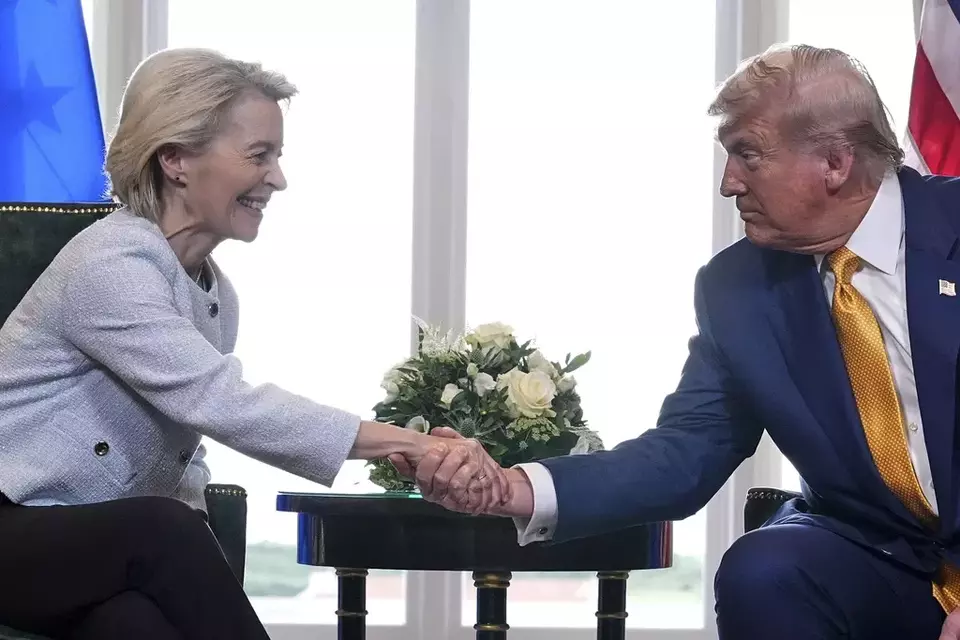
Frankfurt. President Donald Trump and European Commission President Ursula von der Leyen have announced a sweeping trade deal that imposes 15 percent tariffs on most European goods, warding off Trump's threat of a 30 percent rate if no deal had been reached by Aug. 1.
The tariffs, or import taxes, paid when Americans buy European products could raise prices for US consumers and dent profits for European companies and their partners who bring goods into the country.
Here are some things to know about the trade deal between the United States and the European Union:
What's in the Agreement?
Trump and von der Leyen's announcement, made during Trump's visit to one of his golf courses in Scotland, leaves many details to be filled in.
The headline figure is a 15 percent tariff rate on “the vast majority” of European goods brought into the United States, including cars, computer chips and pharmaceuticals. It's lower than the 20 percent Trump initially proposed, and lower than his threats of 50 percent and then 30 percent.
Von der Leyen said the two sides agreed on zero tariffs on both sides for a range of “strategic” goods: Aircraft and aircraft parts, certain chemicals, semiconductor equipment, certain agricultural products, and some natural resources and critical raw materials. Specifics were lacking.
She said the two sides “would keep working” to add more products to the list.
Additionally, the EU side would purchase what Trump said was $750 billion (638 billion euros) worth of natural gas, oil and nuclear fuel to replace Russian energy supplies, and Europeans would invest an additional $600 billion (511 billion euros) in the US.
What's Not in the Deal?
Trump said the 50 percent US tariff on imported steel would remain; von der Leyen said the two sides agreed to further negotiations to fight a global steel glut, reduce tariffs and establish import quotas -- that is, set amounts that can be imported, often at a lower rate.
Trump said pharmaceuticals were not included in the deal. Von der Leyen said the pharmaceuticals issue was “on a separate sheet of paper” from Sunday's deal.
Where the $600 billion for additional investment would come from was not specified. And von der Leyen said that when it came to farm products, the EU side made clear that “there were tariffs that could not be lowered,” without specifying which products.
What's the Impact?
The 15 percent rate removes Trump's threat of a 30 percent tariff. It's still much higher than the average tariff before Trump came into office of around 1 percent, and higher than Trump's minimum 10 percent baseline tariff.
Higher tariffs, or import taxes, on European goods mean sellers in the US would have to either increase prices for consumers -- risking loss of market share -- or swallow the added cost in terms of lower profits. The higher tariffs are expected to hurt export earnings for European firms and slow the economy.
The 10 percent baseline applied while the deal was negotiated was already sufficiently high to make the European Union's executive commission cut its growth forecast for this year from 1.3 percent to 0.9 percent.
Von der Leyen said the 15 percent rate was “the best we could do” and credited the deal with maintaining access to the US market and providing “stability and predictability for companies on both sides.”
What Is Some of the Reactions to the Deal?
German Chancellor Friedrich Merz welcomed the deal which avoided “an unnecessary escalation in transatlantic trade relations" and said that “we were able to preserve our core interests,” while adding that “I would have very much wished for further relief in transatlantic trade.”
The Federation of German Industries was blunter. "Even a 15 percent tariff rate will have immense negative effects on export-oriented German industry," said Wolfgang Niedermark, a member of the federation's leadership.
While the rate is lower than threatened, "the big caveat to today’s deal is that there is nothing on paper, yet," said Carsten Brzeski, global chief of macro at ING bank.
“With this disclaimer in mind and at face value, today’s agreement would clearly bring an end to the uncertainty of recent months. An escalation of the US-EU trade tensions would have been a severe risk for the global economy," Brzeski said.
“This risk seems to have been avoided.”
What about Car Companies?
Asked if European carmakers could still sell cars at 15 percent, von der Leyen said the rate was much lower than the current 27.5 percent. That has been the rate under Trump's 25 percent tariff on cars from all countries, plus the preexisting US car tariff of 2.5 percent.
The impact is likely to be substantial on some companies, given that automaker Volkswagen said it suffered a 1.3 billion euro ($1.5 billion) hit to profit in the first half of the year from the higher tariffs.
Mercedes-Benz dealers in the US have said they are holding the line on 2025 model year prices “until further notice.” The German automaker has a partial tariff shield because it makes 35 percent of the Mercedes-Benz vehicles sold in the US in Tuscaloosa, Alabama, but the company said it expects prices to undergo “significant increases” in coming years.
What Were the Issues Dividing the Two Sides?
Before Trump returned to office, the US and the EU maintained generally low tariff levels in what is the largest bilateral trading relationship in the world, with some 1.7 trillion euros ($2 trillion) in annual trade. Together the US and the EU have 44 percent of the global economy. The US rate averaged 1.47 percent for European goods, while the EU's averaged 1.35 percent for American products, according to the Bruegel think tank in Brussels.
Trump has complained about the EU’s 198 billion-euro trade surplus in goods, which shows Americans buy more from European businesses than the other way around, and has said the European market is not open enough for US-made cars.
However, American companies fill some of the trade gap by outselling the EU when it comes to services such as cloud computing, travel bookings, and legal and financial services. And some 30 percent of European imports are from American-owned companies, according to the European Central Bank.
Tags: Keywords:Related Articles

Trump Calls Off Latest Threats to Strike Iran, Citing Progress in Negotiations
Trump had threatened further escalation earlier Thursday, posting on social media that the US would hit Iran “VERY HARD TONIGHT”.
A War Neither Side Can Control: The Political Costs for Trump and Netanyahu
The US retains military superiority over Iran, but the political trajectory of the war is increasingly slipping beyond its control.
Hegseth Reassures Pacific Allies While Softening China Rhetoric
Hegseth reassured Indo-Pacific allies of U.S. commitment while adopting a more measured tone toward China.
US and Iranian Negotiators Reach Tentative Deal to Extend Ceasefire
Washington and Tehran have repeatedly accused each other of violating the seven-week ceasefire and have traded strikes throughout the week.
Trump Withdraws $10B Suit Against Internal Revenue Service
The decision is part of a deal that would create a $1.7 billion fund to pay allies of the president.
Trump-Xi Meeting Opens in Beijing With Low Expectations on Trade, Security
Trump met Xi in Beijing as both sides opened talks, with little expectation of breakthroughs on Iran, Taiwan and trade.
Rupiah Hit by Global “Perfect Storm,” Weakens to Rp 17,414
Rupiah weakened to Rp 17,414 per dollar as escalating US-Iran tensions and cautious sentiment ahead of US inflation data boosted safe-haven
JCI Dips as Iran-US Tensions Drive Oil to $114
JCI slipped as Hormuz tensions lifted oil to $114, while easing inflation and a trade surplus failed to offset global risks.
JCI Gains 0.22% on Stable Inflation, Trade Surplus Support
JCI rose 0.22% to 6,957 as easing geopolitics and stable inflation offset weak manufacturing signals.
Trump Unveils ‘Project Freedom’ to Escort Ships from Strait of Hormuz
The US will launch Project Freedom to guide ships from the Strait of Hormuz as tensions rise and fresh attacks hit vessels.The Latest

Dear Mr. President, Don’t Skip ASEAN Summits
Despite calls for Prabowo to stay home, the Indonesian leader still needs to attend ASEAN summits.
PLN Rushes Coal Supplies After Power Outages Hit Java
PLN is rushing to secure coal supplies after shortages triggered rolling blackouts across Java, disrupting businesses and daily life.
Japan-Backed ADB Invests in Indonesia’s Human Capital
As many as 399 Indonesian awardees have joined the ADB-Japan Scholarship Program from 1988 to 2024.
Indonesian Stocks Rise Despite Foreign Outflows as MSCI Review Looms
Indonesia's JCI rose 2.8% as easing geopolitical tensions offset foreign outflows, MSCI concerns and rupiah pressures.
World Cup 2026: Paraguay Holds Off Turkey With 10 Men to Keep Knockout Hopes Alive
Matias Galarza scored after 65 seconds as 10-man Paraguay beat Turkey 1-0, eliminating the Turks and securing first place for the US.Most Popular