



Gus Dur’s Legacy Lives On Each Lunar New Year
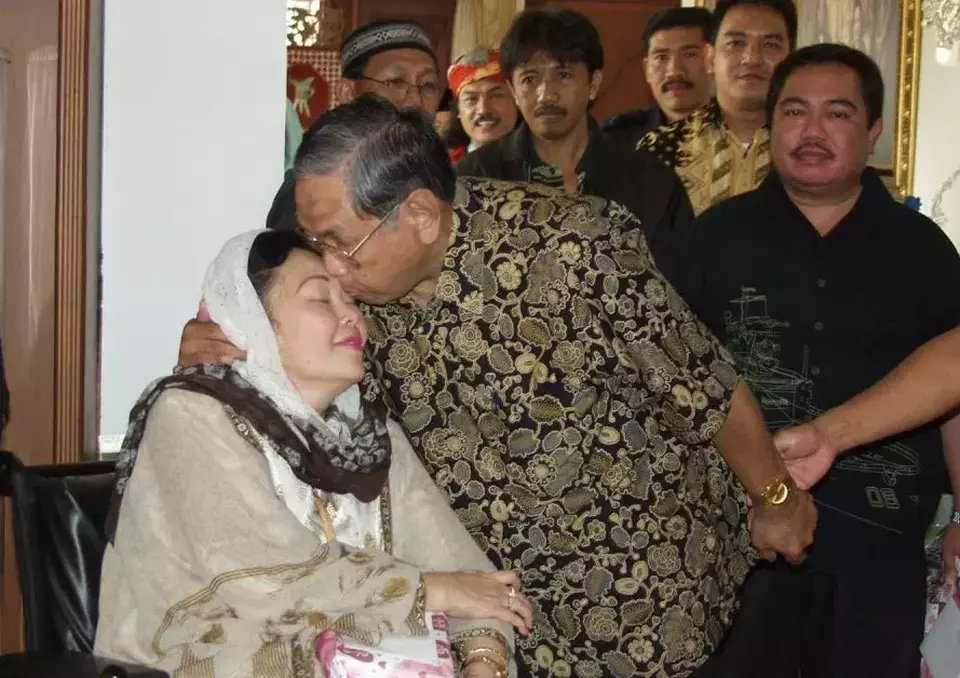
Surabaya. Each Lunar New Year, many Indonesians recall the legacy of former president Abdurrahman Wahid, widely known as Gus Dur, whose reforms paved the way for public celebrations of the holiday after decades of restrictions.
Gus Dur, Indonesia’s fourth president who served from 1999 to 2001, is credited with lifting policies that had suppressed Chinese cultural expression during the authoritarian New Order era under former president Suharto.
Since Gus Dur’s presidency, Lunar New Year — known locally as Imlek — has been openly celebrated across the country, with festive decorations displayed not only in places of worship but also in shopping malls and public spaces.
“His contribution was extraordinary, especially for the Confucian community and ethnic Chinese Indonesians, because it was due to him that Lunar New Year could be celebrated widely,” said Liem Tiong Yang, a Confucian cleric in Surabaya, speaking on Tuesday.
For more than three decades under Suharto’s rule (1966–1998), public displays of Chinese identity were heavily restricted. A 1967 presidential instruction limited the practice of Chinese customs, traditions and religious observances to private settings. The use of Chinese characters in public signage was banned, Chinese-language publications were tightly controlled, and cultural performances such as barongsai lion dances were prohibited in public spaces. Confucianism was also stripped of formal recognition as an official religion, forcing many adherents to register under other faiths.
That changed when Wahid issued Presidential Decree No. 6/2000, revoking a 1967 presidential instruction that had restricted Chinese customs and traditions. The move marked a turning point in the state’s recognition of Indonesia’s ethnic Chinese minority.
Gus Dur later designated Lunar New Year as an optional holiday. In 2003, his successor, President Megawati Soekarnoputri, upgraded the holiday to national status, a designation that remains in place today.
Liem said the holiday has since evolved into a cross-cultural celebration embraced by Indonesians of various faiths.
“Lunar New Year decorations are not only found in places of worship but also in malls. It has become a moment for people of different religions to celebrate togetherness,” he said.
He added that Gus Dur’s pluralist values remain relevant for younger generations in Indonesia, a diverse archipelago of more than 270 million people spanning hundreds of ethnic groups and religions.
“Indonesia was not built by one group alone, but through the joint efforts of many ethnicities and faiths,” Liem said. “What Gus Dur taught — mutual respect, tolerance and human dignity — should be upheld.”
Gus Dur, a Muslim cleric and former leader of the country’s largest Islamic organization, is widely remembered as a champion of minority rights and religious pluralism. His policies on cultural freedom and inclusion continue to shape Indonesia’s approach to diversity more than two decades later.
Indonesia is home to one of the largest ethnic Chinese communities outside mainland China. According to data platform Statista, the country was estimated to have around 11.15 million people of Chinese descent in 2023, making it the largest Chinese diaspora population outside China and equivalent to roughly 4% of Indonesia’s total population.
However, official figures have varied. The most recent ethnicity data from the 2010 population census conducted by the Central Statistics Agency (BPS) recorded 2,832,510 ethnic Chinese residents, but the number may be underreported, as many individuals were reluctant to identify themselves as ethnically Chinese in past censuses due to historical discrimination and assimilation policies.
Tags: Keywords:Related Articles

Jakarta Stocks Start Strong Post-Holiday with Debt Outlook, Trade Deal in Focus
JCI opened 0.27% higher after the Lunar New Year holiday as investors assessed fiscal signals, debt sustainability.
Gus Dur’s Legacy Lives On Each Lunar New Year
Each Lunar New Year, Indonesians recall Gus Dur, the president who lifted bans on Chinese culture and restored Imlek as a public celebration
Lunar New Year Holiday Seen Generating $500 Million in Indonesia
Indonesia’s Lunar New Year holiday is projected to generate over Rp9 trillion in spending, driven by travel, retail and family gatherings.
Lunar New Year Holiday Spurs Travel and Tourism Surge Across Indonesia
Indonesia’s Lunar New Year holiday sparked a nationwide travel surge, boosting tourism, traffic and festive activity during Imlek 2026.Indon
China’s Lunar New Year Travel Rush Begins with Record 9.5 Billion Trips Expected
Some 540 million of those trips will be made via train, and 95 million by air. The rest will be on the road.The Latest

Dear Mr. President, Don’t Skip ASEAN Summits
Despite calls for Prabowo to stay home, the Indonesian leader still needs to attend ASEAN summits.
PLN Rushes Coal Supplies After Power Outages Hit Java
PLN is rushing to secure coal supplies after shortages triggered rolling blackouts across Java, disrupting businesses and daily life.
Japan-Backed ADB Invests in Indonesia’s Human Capital
As many as 399 Indonesian awardees have joined the ADB-Japan Scholarship Program from 1988 to 2024.
Indonesian Stocks Rise Despite Foreign Outflows as MSCI Review Looms
Indonesia's JCI rose 2.8% as easing geopolitical tensions offset foreign outflows, MSCI concerns and rupiah pressures.
