Japan to Export Emissions to Malaysia Under First Carbon Capture Deal

Japan wants to ship carbon emissions to Malaysia in a first-of-its-kind project in Southeast Asia for carbon capture and storage, a widely debated process that critics say is more symbolic than effective in curbing climate change.
Despite such doubts, Malaysia is positioning itself as Southeast Asia's hub for alternative technology, a three-step process that captures, transports, and buries carbon dioxide, which contributes to climate change. With about 81% of Malaysia's electricity generated from fossil fuels, climate activists say carbon capture is an expensive distraction from proven emissions-reducing actions such as transitioning to renewable energy.
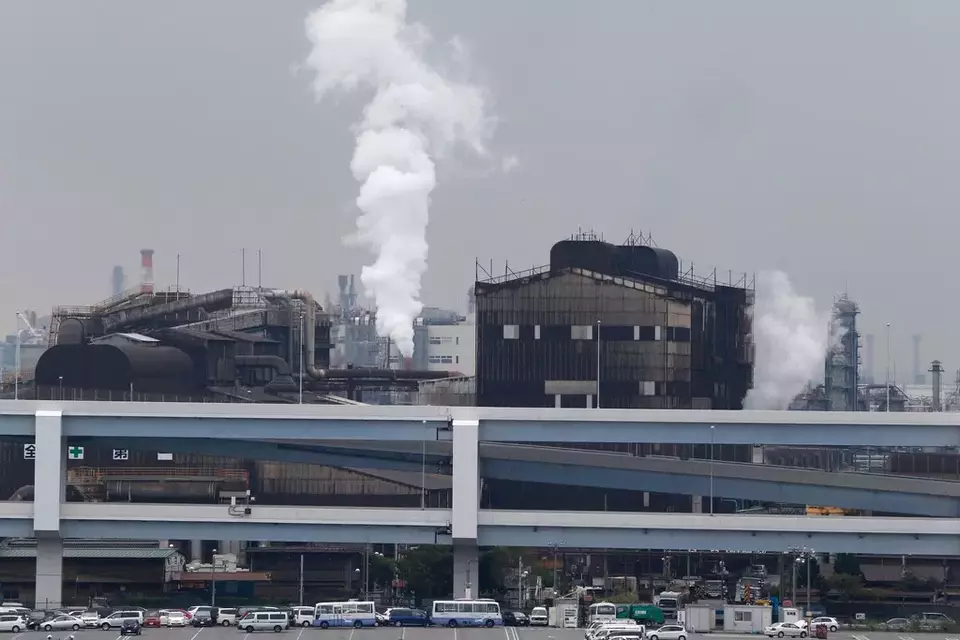
Japan, one of the world's top carbon emitters, plans to ship emissions from its heavily polluting industries –– spanning electric power, oil refining, cement, shipping, and steel –– to Malaysia within the next few years. If the project succeeds, experts say it may blaze a path for other Southeast Asian nations with carbon storage potential, like Indonesia and Thailand.
Detractors say it will slow the progress of already off-track global efforts to curb emissions.
The plan “dangerously shifts the burden of climate change onto Malaysia rather than onto Japan," said Rachel Kennerley, a carbon capture specialist with the Washington-based Center for International Environmental Law.
Doubts about Carbon Capture
The debated process starts with capturing emissions directly from a polluting source, like a refinery or power station. This can be done in different ways, such as retrofitting a facility to emit directly into a storage location or by building vacuum-like structures to suck up emissions.
While Japan and Malaysia have yet to share detailed plans, the carbon dioxide will likely then need to be separated from the other captured gasses emitted during industrial processes.
The carbon will then be liquefied and later transported in specially designed ships to burial sites, likely in depleted gas fields off the coast of the Malaysian state of Sarawak on the island of Borneo.
After the liquefied carbon is injected into the ground the site will have to be monitored for leaks.
Some governments and fossil fuel giants like Exxon Mobil and Shell promote the strategy as a climate solution that buys time for countries and industries to transition to cleaner energy.
The European Union’s first offshore carbon storage facility, taking emissions from Denmark and injecting them into the seabed below the North Sea, is due to start operating by mid-2026. A Norwegian facility launched last year is testing cross-border carbon shipments.
There is “an almost fantastical theoretical uptick” in carbon capture interest, said Grant Hauber, with the US-based Institute for Energy Economics and Financial Analysis. He said it “offers a tantalizing promise that just won’t deliver.”
While the International Energy Agency considers carbon capture, utilization and storage a tool for curbing climate change, the IEA's latest Net Zero Emissions scenario forecasts it will contribute less than 5% of emission reductions by 2050.
Malaysia Pushes for Carbon Capture
Malaysia passed a bill last year promoting the carbon capture industry. Without providing details, the Ministry of Economy, which declined to comment, projected the fledgling sector could add up to $250 billion to the economy within 30 years.
Malaysia’s state-owned oil and gas company, Petronas, is leading the $1.1 billion construction of what will be the world’s largest offshore carbon storage facility, slated to begin operations by the end of the decade. Petronas declined to comment.
Rather than investing in proven decarbonization actions, like solar energy rollouts or grid development, Eqram Mustaqeem, who campaigned against carbon capture in Malaysia, said “we're spending high amounts of money on a technology that is under-delivering and unproven."
Japan Pilots Cross-Border Project
Fossil fuels generate the lion’s share of energy in Japan, which is among the world's top five highest carbon emitters.
Japan is investing in nine carbon storage sites, three of them in Malaysia, to try to cut its net emissions. It estimates that by 2030, the sites will store 20 million tons of carbon annually, roughly 2% of Japan's yearly emissions.
Malaysia will likely be paid an undetermined amount per ton of emissions stored. Japan could then subtract those emissions from its total carbon output.
Government documents show that a range of Japanese companies intend to ship emissions to Malaysia.
Carbon Capture or ‘Climate Colonialism’
Ayumi Fukakusa, of the advocacy group, Friends of the Earth Japan, called the idea of exporting emissions to other countries “carbon colonialism.”
Apart from the doubts about the effectiveness of carbon capture, critics also object to the idea of managing emissions rather than reducing them.
“Japan gets to keep polluting and driving climate change, while claiming to ‘clean up’ its emissions by shipping the carbon to Malaysia," said Kennerley of the Center for International Environmental Law. She said that will make Malaysia “a carbon dumping ground for industrial pollution” and detract from climate action.
Tags: Keywords:Related Articles

Japan to Export Emissions to Malaysia Under First Carbon Capture Deal
Ayumi Fukakusa, an environmental activist, called the idea of exporting emissions to other countries “carbon colonialism.”The Latest

Dear Mr. President, Don’t Skip ASEAN Summits
Despite calls for Prabowo to stay home, the Indonesian leader still needs to attend ASEAN summits.
PLN Rushes Coal Supplies After Power Outages Hit Java
PLN is rushing to secure coal supplies after shortages triggered rolling blackouts across Java, disrupting businesses and daily life.
Japan-Backed ADB Invests in Indonesia’s Human Capital
As many as 399 Indonesian awardees have joined the ADB-Japan Scholarship Program from 1988 to 2024.
Indonesian Stocks Rise Despite Foreign Outflows as MSCI Review Looms
Indonesia's JCI rose 2.8% as easing geopolitical tensions offset foreign outflows, MSCI concerns and rupiah pressures.
World Cup 2026: Paraguay Holds Off Turkey With 10 Men to Keep Knockout Hopes Alive
Matias Galarza scored after 65 seconds as 10-man Paraguay beat Turkey 1-0, eliminating the Turks and securing first place for the US.Most Popular