



Trump Hails ‘Once-in-a-Lifetime Chance’ for Middle East Peace
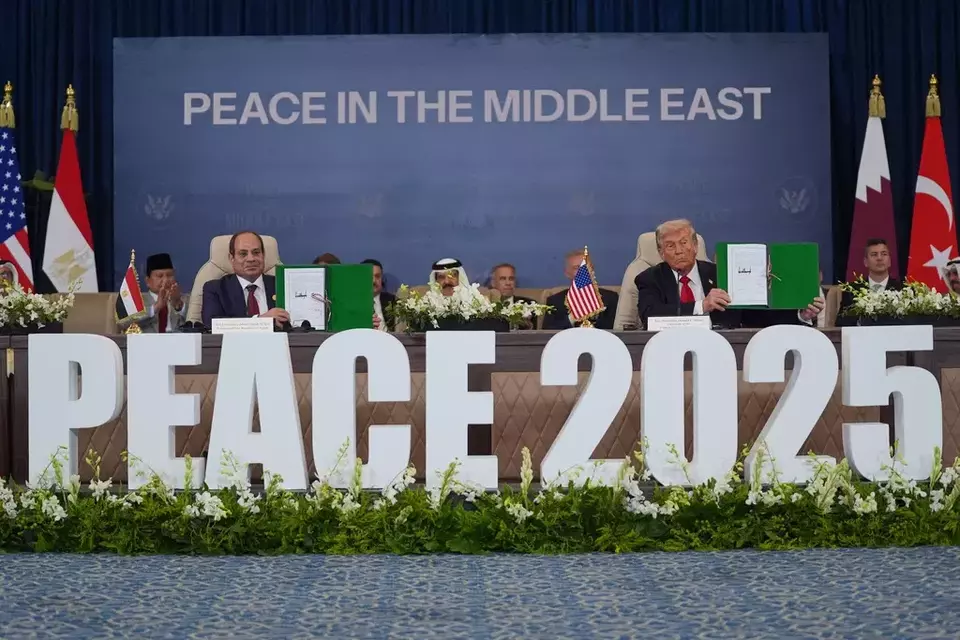
Sharm El-Sheikh, Egypt. President Donald Trump on Monday called for a “new era of harmony” in the Middle East, urging regional leaders to put “old feuds and bitter hatreds” aside as he sought to consolidate a fragile ceasefire between Israel and Hamas and lay the groundwork for Gaza’s reconstruction.
“We have a once-in-a-lifetime chance to put the old feuds and bitter hatreds behind us,” Trump said at a global summit in the Egyptian resort of Sharm el Sheikh, convened to chart Gaza’s future. “Our future will not be ruled by the fights of generations past.”
The meeting followed Trump’s earlier visit to Jerusalem, where he addressed the Israeli Knesset and celebrated what he called “a historic victory for peace” after two years of devastating conflict between Israel and Hamas. The US-brokered ceasefire, sealed after months of negotiations, has brought a cautious sense of relief to a region long accustomed to turmoil.
“Everybody said it’s not possible to do,” Trump said at the summit alongside Egyptian President Abdel Fattah el-Sissi. “And it’s happening before your very eyes.”
Nearly three dozen nations, including key European and Arab states, joined the summit. Israeli Prime Minister Benjamin Netanyahu declined to attend, citing a Jewish holiday, but Trump and other leaders, including Turkish President Recep Tayyip Erdogan and Qatari Emir Tamim bin Hamad Al Thani, signed a joint declaration outlining a framework for Gaza’s governance and reconstruction.
Despite many unanswered questions about the enclave’s political future, Trump portrayed the ceasefire as the first step toward a lasting regional peace. “Now is the time to translate victories on the battlefield into peace and prosperity for the entire Middle East,” he told Israeli lawmakers earlier in the day.
Trump’s Middle East Mission
Trump’s back-to-back visits to Jerusalem and Egypt capped a whirlwind diplomatic push. His Knesset speech drew raucous applause, with lawmakers chanting his name and some wearing red caps that read “Trump, The Peace President.” Netanyahu hailed him as “the greatest friend Israel has ever had in the White House.”
Trump used the occasion to call on Israel’s president to pardon Netanyahu, who faces corruption charges, calling him “one of the greatest wartime leaders.” The comment underscored Trump’s penchant for mixing diplomacy with political theater, as he also used the speech to praise donors and criticize Democratic predecessors.
Later, aboard Air Force One en route to Egypt, Trump told reporters he believed the war was truly over. “The war is over, OK? I think people are tired of it,” he said, suggesting that exhaustion on both sides would help sustain the truce.
The first phase of the ceasefire includes the release of remaining hostages held by Hamas, the freeing of hundreds of Palestinian prisoners, and a gradual Israeli troop pullback from Gaza’s main cities. It also provides for a surge of humanitarian aid into Gaza, where conditions remain dire after two years of bombardment.
Trump said he hoped Gaza could one day become “the Riviera of the Middle East,” though he admitted its reconstruction would take years. “It’s blasted,” he said. “This is like a demolition site. But I’d like to put my feet on it, at least.”
Under the deal, Israel will reopen five border crossings to allow food and medical aid into the territory, where famine-like conditions persist. About 200 US troops, along with international partners and NGOs, will help monitor and support the ceasefire implementation.
Celebrations and Pain as Prisoners Freed
While world leaders met in Egypt, jubilant scenes erupted across the West Bank and Gaza as Israel released nearly 2,000 Palestinian prisoners in exchange for Israeli hostages freed by Hamas under the ceasefire deal.
In Beitunia, a town near Ramallah, crowds cheered and waved flags as buses from the International Committee of the Red Cross arrived carrying freed detainees. In Gaza’s Khan Younis, gunfire rang out in celebration as newly released prisoners, wearing gray jumpsuits, stepped off buses to embrace waiting relatives.
“It was an indescribable journey of suffering — hunger, unfair treatment, oppression, torture and curses — more than anything you could imagine,” said Kamal Abu Shanab, 51, from Tulkarem, who was freed after 18 years in prison. His niece said the family barely recognized him after he lost nearly 60 kilograms during incarceration.
According to Israel’s Justice Ministry, those released included roughly 1,700 Palestinians seized during the war and held without charge, and 250 convicted prisoners, some serving multiple life sentences for deadly attacks on Israelis dating back decades.
Of those, 154 were exiled to Egypt and will be resettled in third countries, while the rest returned to their homes in Gaza, the West Bank, and East Jerusalem.
Deep Divides Remain
The releases have struck deep emotional chords on both sides. For many Israelis, they are painful reminders of past terror attacks; for Palestinians, they are moments of national pride, as nearly every family has experienced imprisonment under Israel’s occupation.
While Israel considers many of the detainees terrorists, Palestinians often view them as resistance fighters. Rights groups and former prisoners have long criticized conditions in Israeli prisons, citing isolation, abuse, and lack of medical care. Israel denies systematic mistreatment, saying it adheres to legal standards and investigates any violations.
Despite official warnings against public celebrations, crowds gathered near Ofer Prison in the West Bank, waving flags and chanting slogans. Israeli troops fired tear gas and rubber bullets to disperse the gathering.
A Fragile Peace
The ceasefire and prisoner exchange mark the most significant breakthrough in years of intermittent negotiations between Israel and Hamas, yet the situation remains precarious.
Israel insists Hamas must disarm and relinquish control of Gaza, while Palestinians demand full sovereignty and international guarantees for reconstruction. Failure to reach consensus could quickly reignite tensions.
Among the freed prisoners are figures long seen as symbols of the Palestinian struggle, including Mahmoud Issa, a Hamas commander jailed since 1993, and the Shamasneh brothers, convicted of a deadly 1990 attack during the First Intifada. High-profile detainees such as Marwan Barghouti, viewed as a possible successor to Palestinian President Mahmoud Abbas, were not included in the release.
For now, Trump is claiming victory, both diplomatic and symbolic, as he seeks to redefine America’s role in the Middle East. “We have the chance to build something entirely new,” he said in Sharm el Sheikh. “A future not ruled by the past.”
But with Gaza still in ruins, thousands displaced, and deep mistrust between Israelis and Palestinians, the promise of harmony remains uncertain.
As night fell over the Red Sea, Trump boarded Air Force One to return to Washington, declaring that history was being made. “This is just the beginning,” he said. “Peace is possible and it’s happening.”
Tags: Keywords:Related Articles

Trump Calls Off Latest Threats to Strike Iran, Citing Progress in Negotiations
Trump had threatened further escalation earlier Thursday, posting on social media that the US would hit Iran “VERY HARD TONIGHT”.
A War Neither Side Can Control: The Political Costs for Trump and Netanyahu
The US retains military superiority over Iran, but the political trajectory of the war is increasingly slipping beyond its control.
Hegseth Reassures Pacific Allies While Softening China Rhetoric
Hegseth reassured Indo-Pacific allies of U.S. commitment while adopting a more measured tone toward China.
US and Iranian Negotiators Reach Tentative Deal to Extend Ceasefire
Washington and Tehran have repeatedly accused each other of violating the seven-week ceasefire and have traded strikes throughout the week.
Trump Withdraws $10B Suit Against Internal Revenue Service
The decision is part of a deal that would create a $1.7 billion fund to pay allies of the president.
Trump-Xi Meeting Opens in Beijing With Low Expectations on Trade, Security
Trump met Xi in Beijing as both sides opened talks, with little expectation of breakthroughs on Iran, Taiwan and trade.
Rupiah Hit by Global “Perfect Storm,” Weakens to Rp 17,414
Rupiah weakened to Rp 17,414 per dollar as escalating US-Iran tensions and cautious sentiment ahead of US inflation data boosted safe-haven
JCI Dips as Iran-US Tensions Drive Oil to $114
JCI slipped as Hormuz tensions lifted oil to $114, while easing inflation and a trade surplus failed to offset global risks.
JCI Gains 0.22% on Stable Inflation, Trade Surplus Support
JCI rose 0.22% to 6,957 as easing geopolitics and stable inflation offset weak manufacturing signals.
Trump Unveils ‘Project Freedom’ to Escort Ships from Strait of Hormuz
The US will launch Project Freedom to guide ships from the Strait of Hormuz as tensions rise and fresh attacks hit vessels.The Latest

Dear Mr. President, Don’t Skip ASEAN Summits
Despite calls for Prabowo to stay home, the Indonesian leader still needs to attend ASEAN summits.
PLN Rushes Coal Supplies After Power Outages Hit Java
PLN is rushing to secure coal supplies after shortages triggered rolling blackouts across Java, disrupting businesses and daily life.
Japan-Backed ADB Invests in Indonesia’s Human Capital
As many as 399 Indonesian awardees have joined the ADB-Japan Scholarship Program from 1988 to 2024.
Indonesian Stocks Rise Despite Foreign Outflows as MSCI Review Looms
Indonesia's JCI rose 2.8% as easing geopolitical tensions offset foreign outflows, MSCI concerns and rupiah pressures.
