



Migrant Worker Protection Strengthened Through Cross-Sector Partnerships
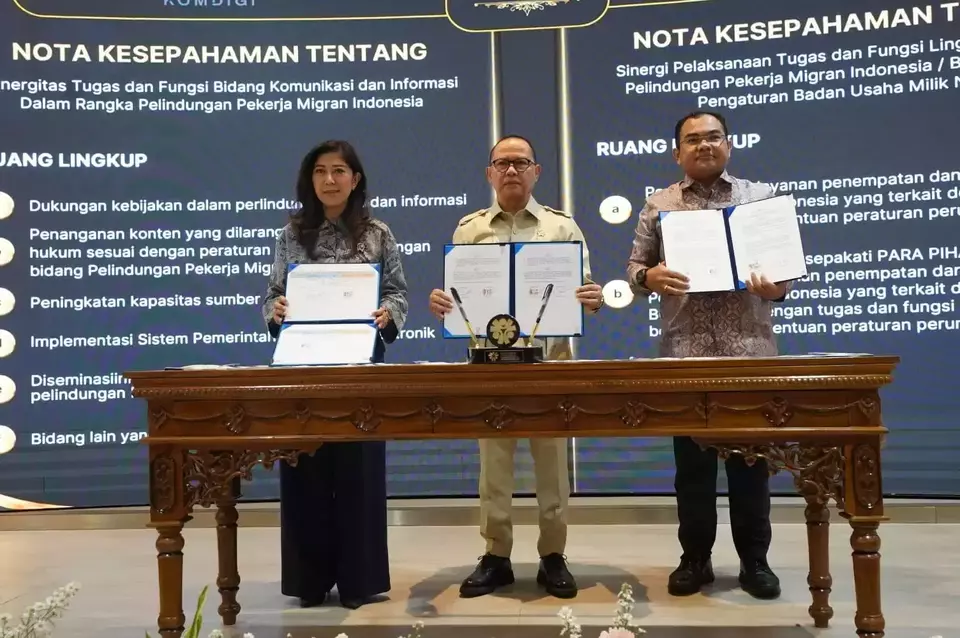
Jakarta. The Ministry for the Protection of Migrant Workers on Monday signed 13 memoranda of understanding and five cooperation agreements with 14 strategic partners to strengthen cross-sector coordination in safeguarding Indonesian workers abroad.
The agreements bring together a wide range of stakeholders, including the Communication and Digital Affairs Ministry, the State-Owned Enterprises Supervisory Agency, regional governments, universities, vocational institutions, civil society groups, and healthcare providers. Among the partners are the Deli Serdang regional administration, the Bandung Institute of Technology, Brawijaya University, Syiah Kuala University, Indonesia Ocean Justice Initiative, and several training institutions and hospitals.
The cooperation aligns with President Prabowo Subianto’s directive to enhance comprehensive protection for migrant workers while improving the skills and competitiveness of prospective workers in the global labor market.
Minister for the Protection of Migrant Workers Mukhtarudin said the agreements would help ensure that guidance, training, and protection efforts are more structured and effective.
“Migrant worker issues are a shared responsibility, and these agreements reflect the collective concern of stakeholders across Indonesia,” he said after the signing ceremony.
Mukhtarudin stressed that migrant workers remain a vulnerable group, working overseas not merely as economic contributors but to sustain their families’ livelihoods. He stressed that migrant workers must be treated as individuals with dignity and rights, rather than as labor commodities.
He also noted that the elevation of the migrant worker protection body into a standalone ministry underscores the government’s seriousness in ensuring their welfare and safety.
“The state must be present to ensure migrant workers gain decent employment, legal assistance, and adequate protection so they can support their families,” he said, urging companies and stakeholders to balance commercial interests with humanitarian responsibility.
One of the key agreements, with the Ministry of Communication and Digital Affairs, targets the growing risk of fraud faced by migrant workers, particularly from illegal job advertisements circulating on social media. The partnership aims to strengthen digital monitoring, information literacy, and enforcement against online exploitation.
Communication and Digital Affairs Minister Meutya Hafid reaffirmed her ministry’s commitment to protecting migrant workers from cybercrime, noting their significant contribution to the national economy through remittances, which totaled around Rp 253 trillion, or $15.2 billion, last year.
“As of mid-December 2025, we have handled more than 300 fraud complaints related to migrant worker recruitment, mostly involving fake job postings on social media,” she said, adding that the agreement would accelerate reporting mechanisms and illegal content takedowns.
Meanwhile, Deputy Head of the State-Owned Enterprises Supervisory Agency Tedi Bharata described migrant workers as national assets who must be protected to ensure they work safely and return home in good condition. He expressed hope that skills gained overseas would contribute to Indonesia’s development upon their return.
Through these partnerships, the government aims to build a more integrated and humane migrant worker protection system, combining policy, education, digital safeguards, and community support to enhance Indonesia’s global workforce competitiveness.
Tags: Keywords:Related Articles

Indonesia Plans Phone Verification for Social Media Users to Curb Anonymous Accounts
Indonesia plans mandatory phone verification for social media users to reduce fake accounts, hoaxes, and cybercrime.
Communications Ministry Denies Sharing Citizens’ Data with US
Indonesia denies sharing citizens’ data with the US under a new trade pact despite backlash over cross-border data rules.
Indonesia’s Top Telecom Operators Compete in Key 5G Spectrum Auction
Indonesia’s biggest telecom operators compete for strategic 5G spectrum to expand high-speed internet nationwide.
Roblox Joins Google in Rolling Out Indonesia’s Child Safety Safeguards
Google tightens child safety rules in Indonesia, with Roblox aligning through age checks, chat limits, and parental controls.
Indonesia Says YouTube, Roblox Yet to Comply with Age Limits
The government warned that YouTube and Roblox have a three-month deadline to submit self-assessment reports on their risk profiles.
Indonesia Summons Meta, Google Over Non-Compliance With Child Protection Rules
Indonesia summons Meta and Google over non-compliance with new child protection rules, requiring safer access for underage users online.
Indonesia Praises X, Bigo Live for Enforcing Child Age Limits on Social Media
Indonesia praises X and Bigo Live for enforcing age limits, warning other platforms to comply with strict child protection rules.
Indonesia Restricts Social Media Access for Children Under 16
Indonesia bans children under 16 from high-risk digital platforms like TikTok and Instagram under a new rule to protect minors
Indonesia Rejects Claim It Will Hand Over Data of 280 Million Citizens to US
Cross-border data transfers occur when Indonesian citizens voluntarily use US-based digital platforms, such as social media services.
New Indonesian SIM Card Rules Mandate Biometrics for Locals, Passports for Foreigners
Indonesia now requires biometric SIM registration, limiting phone numbers per user as the government steps up efforts to curb digital fraud.The Latest

Dear Mr. President, Don’t Skip ASEAN Summits
Despite calls for Prabowo to stay home, the Indonesian leader still needs to attend ASEAN summits.
PLN Rushes Coal Supplies After Power Outages Hit Java
PLN is rushing to secure coal supplies after shortages triggered rolling blackouts across Java, disrupting businesses and daily life.
Japan-Backed ADB Invests in Indonesia’s Human Capital
As many as 399 Indonesian awardees have joined the ADB-Japan Scholarship Program from 1988 to 2024.
Indonesian Stocks Rise Despite Foreign Outflows as MSCI Review Looms
Indonesia's JCI rose 2.8% as easing geopolitical tensions offset foreign outflows, MSCI concerns and rupiah pressures.
